Mahakali Treaty Anniversary Revives Allegations of Weak Negotiation
Bhutan Khabar
Writer at Bhutan Khabar
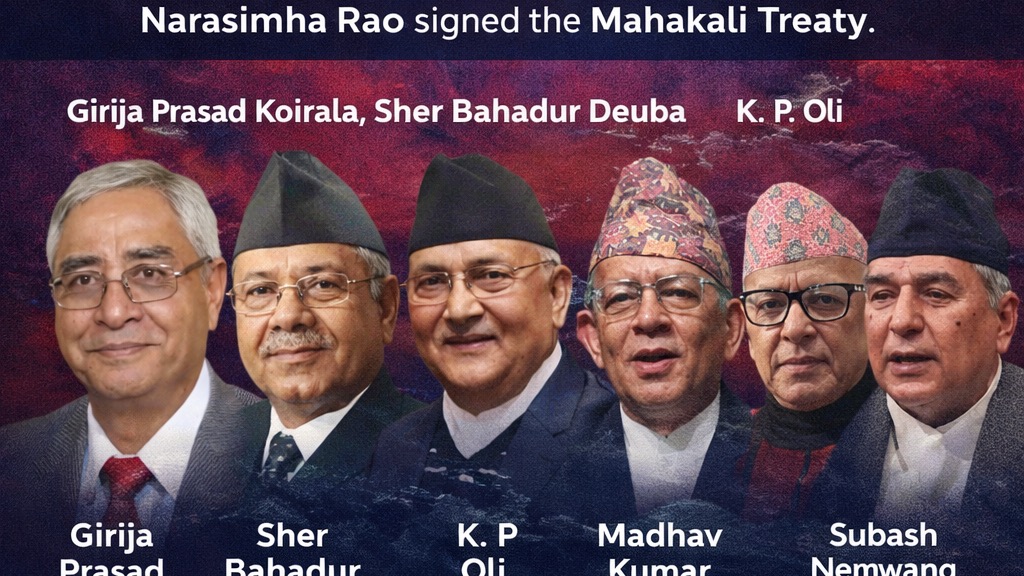

Mahakali Treaty: Anniversary Rekindles Public Debate in Nepal
Today marks Magh 29 in the Nepali calendar. On this day in 2052 B.S. (1996 A.D.), Nepal’s Prime Minister Sher Bahadur Deuba and then Indian Prime Minister P. V. Narasimha Rao signed the Mahakali Treaty, a landmark agreement concerning the development and utilization of the Mahakali River, which forms part of the border between Nepal and India.
The treaty was concluded under the direct supervision of then Nepali Congress President Girija Prasad Koirala. Several prominent political figures were involved in the process, including Minister for Water Resources Pashupati Shumsher, Foreign Minister Prakash Chandra Lohani, Speaker Ram Chandra Poudel, and key leaders such as K.P. Oli, Madhav Kumar Nepal, Subash Nemwang, and Ishwor Pokhrel. Their roles were considered significant in shaping the political consensus required for ratification.
At the time, the treaty required a two-thirds majority in Parliament. According to public statements made by current Speaker Devraj Ghimire, during the hospitalization of then Prime Minister Manmohan Adhikari, authority was granted to cast a decisive vote based on the recommendation of senior leaders, including K.P. Oli and Madhav Kumar Nepal. That vote ultimately contributed to the treaty’s approval.
Over the years, the Mahakali Treaty has remained a subject of debate in Nepal. While supporters argue that it provides a framework for shared water resource development and hydropower cooperation, critics contend that the agreement did not adequately safeguard Nepal’s long-term interests.
On its anniversary, public discussions have resurfaced across political and social platforms. Many citizens continue to question whether the treaty delivered the expected benefits, while others defend it as a diplomatic necessity of its time. The issue remains intertwined with broader debates about nationalism, sovereignty, and the management of Nepal’s natural resources.

Comments (0)
You need to be logged in to comment
Login to CommentNo comments yet. Be the first to comment!
Related Articles



 PREMIUM